As mentioned last time, I now have a slightly different goal than previously outlined. My new quest is not necessarily to make money off of MTGO, but to be able to sustain infinite play (still planning on going infinite!) in tournaments, namely drafting, because that's the fun stuff. While going infinite will probably result in net profit from MTGO, if I can draft essentially for free, I would be satisfied with that.
This comes about from a realization about playing Magic, which is that I should play for fun, rather than to make money. The potential profits as a casual player really are not that large in comparison to just holding a job. I could grind Momir Basic and Pauper dailies all day. Even with a 17% return on entry fee on average, which I'm sure any market player would love to have, since the base investment is both low and fixed, there really isn't much gain to be made. Momir Basic is a hilariously fun format, but it loses its luster after playing too many games in one sitting.
However, this will not change the course of the blog too much. It means more commentary on winning drafts than winning constructed, and I hope that this will shed some insight as to why I appear to be ignoring the basic financial sense I'll be going into in the near future. (I mean, I am.) This will also be why you probably won't see any analysis on setting up bots (seemingly a good way to make money) or card speculation. I plan on doing draft commentary, and hopefully that will help me improve as a drafter as well.
In the end, the way to go infinite is still to win. Have winning records, and you'll get to play more. It's definitely not as easy as that though. The MTGO scene, I've read, is a lot more competitive than the IRL scene, and that's justifiable, since people willing to pay money for pieces of cardboard that aren't even tangible must be dedicated to the game. (I'm included in there, haha.)
That's all for today, just a short post. More tomorrow.
Tuesday, June 25, 2013

Monday, June 24, 2013
Why Arbitrage Fails
We're back, after a brief break. I'm going to write this post as promised, but then take a slightly different turn with this blog. I'll explain what's happening and my reasoning in the next post.
So, let's talk arbitrage. There are several sources of arbitrage in the MTGO secondary market. Human-to-human, human-to-bot, bot-to-human, and bot-to-bot. To clairfy, human-to-bot is where you buy from a human and sell to a bot, and make the difference. I can tell you now that none of these are worth the time. It can take quite a while to find a buyer and a seller, of which the buy price is higher than the sell price, and where both parties are guaranteed to buy or sell, respectively.
This is the first risk. Since you don't know all the information on either side, you take on appreciable risk when you attempt to conduct arbitrage. Your buyer might decide not to buy after all, or your seller might decide to keep their cards. The latter is the preferred scenario, since then all you need to do is apologize to the buyer and move on. The former is the more problematic; when you can't actually sell a card, it becomes deadweight to you. You've lost tix buying it, and if you sell it to a bot, it will be drastically undervalued. Bots always undervalue what you sell to them and overvalue what you buy; it makes basic economic sense to them.
Now, this risk could be worth taking on, if it were met with equivalent reward. But in the market, the reward is extremely limited by the game itself. Players generally find more than four of a card (a playset) to be useless, and bots will generally not hold more than four or eight copies of a card. This means that, unlike stocks, profit is very limited. Even if you find a few bots to sell to, you're not moving more than twelve copies of a card for more than 0.25 tix of profit each, and even that's a scenario I've never reached. A more reasonable scenario would be moving two copies of a card to one bot at 0.1 tix of profit each, after 10-20 minutes of searching. Definitely not worth the time.
In addition, remember, that 1 tix is the smallest amount of currency you can move from bot to bot. Though bots hold credit, buying two cards at 0.3 tix each and unloading them to two different bots for 0.6 tix each still loses you one ticket since the original bot will require one ticket to buy the cards in the first place and hold 0.4 credit. Over many transactions you might end up with your net tix in the black, but in the short-term, it's not worth it. It's not even worth it in the long-term really, when you weigh it against how much time you spend on it.
A final source of risk comes from convertibility. Credit is all well and good to have on bots, but ultimately you want to be able to convert those credits to tix. This further limits your field as you have to ensure every bot chain your sell to has tix with which you can cash out, or comparable value cards. Sometimes, if you sell at a grossly overpriced rate to a chain (e.g. runo7ke, I think the bot was) all their cards will also be grossly mispriced, and on top of that, have no actual value.
One thing I have yet to try is card speculation. What I've done so far is more akin to day trading, but I imagine buying cards and holding on to them for months could be profitable in the long-term. You could use a site like mtggoldfish.com (I actually don't know of another like it!) to watch your prices and follow trends. I'm thinking about doing this in the future, but right now, I want to wait until the release of M14 and maybe even Theros to see how booster pack and card prices are impacted by both new set releases and cards phasing out of standard before I enter the market there.
But in short, making tix through arbitrage isn't worth it because even without considering risk, the time consumed vastly outweighs the reward.
So, let's talk arbitrage. There are several sources of arbitrage in the MTGO secondary market. Human-to-human, human-to-bot, bot-to-human, and bot-to-bot. To clairfy, human-to-bot is where you buy from a human and sell to a bot, and make the difference. I can tell you now that none of these are worth the time. It can take quite a while to find a buyer and a seller, of which the buy price is higher than the sell price, and where both parties are guaranteed to buy or sell, respectively.
This is the first risk. Since you don't know all the information on either side, you take on appreciable risk when you attempt to conduct arbitrage. Your buyer might decide not to buy after all, or your seller might decide to keep their cards. The latter is the preferred scenario, since then all you need to do is apologize to the buyer and move on. The former is the more problematic; when you can't actually sell a card, it becomes deadweight to you. You've lost tix buying it, and if you sell it to a bot, it will be drastically undervalued. Bots always undervalue what you sell to them and overvalue what you buy; it makes basic economic sense to them.
Now, this risk could be worth taking on, if it were met with equivalent reward. But in the market, the reward is extremely limited by the game itself. Players generally find more than four of a card (a playset) to be useless, and bots will generally not hold more than four or eight copies of a card. This means that, unlike stocks, profit is very limited. Even if you find a few bots to sell to, you're not moving more than twelve copies of a card for more than 0.25 tix of profit each, and even that's a scenario I've never reached. A more reasonable scenario would be moving two copies of a card to one bot at 0.1 tix of profit each, after 10-20 minutes of searching. Definitely not worth the time.
In addition, remember, that 1 tix is the smallest amount of currency you can move from bot to bot. Though bots hold credit, buying two cards at 0.3 tix each and unloading them to two different bots for 0.6 tix each still loses you one ticket since the original bot will require one ticket to buy the cards in the first place and hold 0.4 credit. Over many transactions you might end up with your net tix in the black, but in the short-term, it's not worth it. It's not even worth it in the long-term really, when you weigh it against how much time you spend on it.
A final source of risk comes from convertibility. Credit is all well and good to have on bots, but ultimately you want to be able to convert those credits to tix. This further limits your field as you have to ensure every bot chain your sell to has tix with which you can cash out, or comparable value cards. Sometimes, if you sell at a grossly overpriced rate to a chain (e.g. runo7ke, I think the bot was) all their cards will also be grossly mispriced, and on top of that, have no actual value.
One thing I have yet to try is card speculation. What I've done so far is more akin to day trading, but I imagine buying cards and holding on to them for months could be profitable in the long-term. You could use a site like mtggoldfish.com (I actually don't know of another like it!) to watch your prices and follow trends. I'm thinking about doing this in the future, but right now, I want to wait until the release of M14 and maybe even Theros to see how booster pack and card prices are impacted by both new set releases and cards phasing out of standard before I enter the market there.
But in short, making tix through arbitrage isn't worth it because even without considering risk, the time consumed vastly outweighs the reward.
Tuesday, June 18, 2013
The Secondhand Market
One of the first things I did upon entering the MTGO client was take a look at the classifieds. These are a quick way for players to buy, sell, or trade cards. There are also a large number of bot chains in the classifieds. Most of them are run off of MTGOLibrary's bot software; MTGOLibrary is a service which is free apart from a royalty on every dollar made. The bot chains have varying prices, as people do, but you can be guaranteed there will be a noticeable disparity between how much they buy for and how much they sell for. (Hint: the second one is way higher).

I learned about this disparity the hard way. Initially, one of the tips I read about going infinite said to play the market, and take advantage of opportunities for arbitrage. I decided to employ this by buying a Savageborn Hydra for a little under 1 tix. I soon found out there was nowhere (even the places that advertised as such) which bought the Hydra for 1 tix. I'd lost out on my first investment, and that sucked. Admittedly, it was only one dollar, but it was still a losing investment.


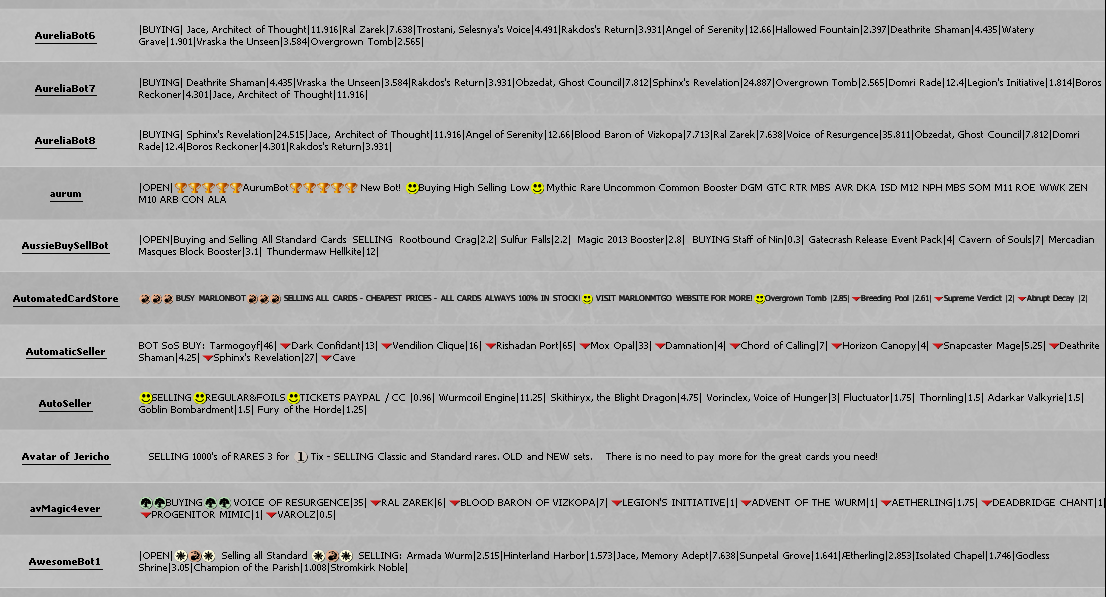
Some people run multiple bots to increase the number of
transactions they can perform and their visibility.
e.g. the Aurelia chain above
I learned about this disparity the hard way. Initially, one of the tips I read about going infinite said to play the market, and take advantage of opportunities for arbitrage. I decided to employ this by buying a Savageborn Hydra for a little under 1 tix. I soon found out there was nowhere (even the places that advertised as such) which bought the Hydra for 1 tix. I'd lost out on my first investment, and that sucked. Admittedly, it was only one dollar, but it was still a losing investment.

This experience taught me two important things about the market, and specifically bots.
First, the prices bots display are often not reflective of their current prices. It will display somewhere in the right range, but expect it to very by +/- 0.5 tix. It's not much but it can mean the difference between paying an extra dollar or not.

This bot might only be buying Sphinx's Revelation for 25 tix.
While this is not too significant for larger buys, when trying to make money through arbitrage, it really matters to know that prices are stable, or else you take on risk disproportionate to your possible return.
Second, bots will try and stiff you. And not just by buying low and selling high. Since the lowest denomination of currency is 1 tix, for smaller purchases with humans, if you can't find a card of theirs of equivalent value they want to trade out, you may have to spend 1 tix just to buy that card, which is crappy if the card is worth a few cents. The bot system has found a way around this by storing credit; unused tix from the last purchase are stored for future purchases. The good bots will also have tickets available if your credit ever goes above 1 tix so you can "cash out", so to speak.

Be careful though; even if a bot says they store credit, that might be a farce. The vast majority of bots won't be petty enough to do this since they want return customers however. In the end though, it's the difference of 1 tix, so not too big of a deal. (Though those tix here and there can add up...)
The more important thing you want to avoid is bot chains where you can't cash out. If you make a sale to a bot chain, be sure they hold tickets that you can take. Otherwise all you have is bot credit, which might not be worth much at all. Early on, I found a trade opportunity where I could buy Wit's End for 0.05 tix and sell for 0.5 tix; I leapt on that opportunity, only to find that my new credits at that particular bot shop were nonconvertible into tix. This bot shop had inflated prices on everything, and their stock was equally worthless. Luckily, I wasn't out much at all, but that was another lesson learned.
Back to the main point. When I say bots will stiff you, I mean they will buy cards from you for 1.99 tix instead of 2, and sell cards to you for 2.01 tix instead of 2. Since they make so many transactions a day, keeping one tix per transaction can be huge for them. There are some bot chains which stay away from this practice, and I tend to give them more business. In all other cases, where the price of a card is not right around the dollar, it's better since a variance of 0.01 tix for a 2.50 card makes little difference.
In the end, I did manage to sell the Hydra off, along with one other rare for 1 tix. This put me back in my original position, plus a negligible amount of credit and down one bulk rare, so effectively unchanged. In the next few trades I made, I found that arbitrage, while existent in the MTGO market, is really not worth the effort and risk. I'll go into why it really does not work with some more tips on how to effectively use the market next post.
Sunday, June 16, 2013
Starting Out
Finally, the juicy stuff! The first few posts will be talking about things that have already happened. Hopefully I will be able to write fast enough to catch up with present times, but we'll see. I'm going to be saying a lot of "I'll explain this later" in the next few posts as I catch up.
To give you some extra motivation to read through this, while I am $34 in the hole on MTGO currently (probably better than some can say :P) my net worth on MTGO, due to some incredible luck, is $79. That is, if I cashed out right now, I would be $46 richer than I was ten days ago. It's small change, but at the same time, 136% returns. I am sure the investor inside you would be perfectly happy with that. (I admit it's probably not sustainable over the long run.)
Day 1: When I finally broke down and bought an account, I had my eyes on one thing: Momir Basic. This was supposedly a format which took away the skill and had a consistent net positive payout. That in itself sounded excellent, but on top of that, the format sounded like a blast.
Momir Basic is a variant on the Vanguard format (which is something very similar to Commander/EDH. You can read more about it here.) in which both players must use the Momir Vig avatar and a deck which consists of 60 lands. Now, Momir's ability is simple: pay X, discard a card: put a creature token of a random creature token with CMC X into play. In other words, the format is completely random.

Well, not completely. There is still some skill involved. But chance plays a much larger role in this format than any other, except maybe Jhoira.
Momir Vig can be bought in the official store for $10, along with some basic lands and some guru lands. There is also some demand for Momir in the secondary markets. You can expect to sell him for 10 and buy him for 12.


To give you some extra motivation to read through this, while I am $34 in the hole on MTGO currently (probably better than some can say :P) my net worth on MTGO, due to some incredible luck, is $79. That is, if I cashed out right now, I would be $46 richer than I was ten days ago. It's small change, but at the same time, 136% returns. I am sure the investor inside you would be perfectly happy with that. (I admit it's probably not sustainable over the long run.)
Day 1: When I finally broke down and bought an account, I had my eyes on one thing: Momir Basic. This was supposedly a format which took away the skill and had a consistent net positive payout. That in itself sounded excellent, but on top of that, the format sounded like a blast.
Momir Basic is a variant on the Vanguard format (which is something very similar to Commander/EDH. You can read more about it here.) in which both players must use the Momir Vig avatar and a deck which consists of 60 lands. Now, Momir's ability is simple: pay X, discard a card: put a creature token of a random creature token with CMC X into play. In other words, the format is completely random.
Momir Vig can be bought in the official store for $10, along with some basic lands and some guru lands. There is also some demand for Momir in the secondary markets. You can expect to sell him for 10 and buy him for 12.

The added premium for Momir in the secondary market seems to be the cost of not having to pay in cash. For instance, once you've gone infinite, if it comes down to the choice of buying Momir with tix for 12 or paying for him with $10, it's likely you'll opt for 12 tix because you effectively have infinite tix. (Hence, gone infinite.)
Now, I didn't dive into this format right away, mainly because I didn't feel like dropping more money down after having already spent $10 for an account and all its goodies.
Speaking of which, let's talk about what you exactly get with an account.
- An assortment of M13 cards (commons, some uncommons)
- DotP cards (only usable in select formats, cannot be mixed with normal cards)
- One M13 booster pack
- Two event tickets (effectively $2)
- Four new player tickets
- Five Vanguard avatars

Since you're here to talk money, let's talk money. The Vanguard avatars, DotP cards, and M13 card assortment you initially get is about worthless. The M13 cards are good for constructing some decks, but you don't really get enough to make anything meaningful. It's still best to hold onto them though since there are some here and there which you'll make use of. As you can see, I have yet to even open my DotP package. I hear it makes for an easier transition from the DotP games, but if you're an experienced M:tG player, you probably don't need these. I can't comment on players just starting out, however.
The four new player tickets are interesting. At first it seems like you've been given effectively $4 for special new-player-only tournaments, which should be even better than event tickets since these new player tournaments should be less competitive, right?
Maybe. I don't actually know. I still have all of my new player tickets; they're really not worth using. Here's why:
In order to participate in a new player event, you need one new player ticket and one event ticket. You compete with some other people in a phantom draft or sealed (meaning you keep none of the cards) for the grand prize of a promo card and a Magic 2013 booster, if you win two our of two rounds. While the new player tickets might be good for getting used to drafts or the interface at lower cost, you can play games for free in the free play area if you want to get used to the interface, and reading drafting strategy or doing real phantom drafts for real prizes is probably best. That being said, these have an EV comparable to other events, so they might be worth doing early on.
EDIT: I've revised the above paragraph since discovering new player events also give out a Magic 2013 booster. It may be worth using these tickets after all.
The two event tickets are self-explanatory. They're worth $2, same as it costs to buy them. The M13 booster pack is interesting though. While you might be tempted to open it at first, I'll parrot the advice I heard from elsewhere - don't. You instantly lose a ton of the value just in opening it for a chance to gain something cool. Hold onto it instead.
Now, I read somewhere that you could also sell this booster pack away for tix. Don't do this either; I learned the hard way. Unless the price is high (~3 tix) and you are okay with waiting for the price to drop (and it will; I came in when it was at ~2.2 tix) before you draft M13, or you just never intend to draft M13, wait on it. I sold my pack for 2.1 tix, and the next day, went and bought three packs do draft with for 2.2 each. A net loss of 10 cents isn't much, but it could have been worse. Please note that selling for 2.9 tix is not the same as selling for 3 tix. The difference is a little more than 10 cents; I'll get into this when I talk about the classifieds section.
I imagine these last two paragraphs will be obsolete this summer once M14 hits; new accounts will be outfitted with a pack of M14 and M14 cards rather than M13 cards. However, this should still hold true, just that a high price for M14 will be about 4.1 tix and a good low for buying in will be 3 tix for a few months.
So, that's Momir Basic and new accounts in a nutshell. I'll be back to cover the secondary market for MTGO next time!
Motivations
I guess I should explain some of my motivation for writing this blog. When I initially set out on my search for articles on going infinite, I found a lot of helpful resources, but most of them were very old, referencing Lorwyn and Shards of Alara. The most recent one talked about Magic 2012. Of course there were forum posts and short articles posted more recently, but the forum posts were not always structured and the short articles were either shameless rehashes of old articles, or meaningless fluff.
On the other hand, I also wanted to keep a record of my own journey, to see how well or poorly I had done. I considered making a spreadsheet to track in and outflows of cash and tix but thought a more public documentation could be fun as well.
So, this blog was born. I hope that it will provide both new players considering getting into MTGO and veterans looking to spend less on the game insight into the process of going infinite, to learn from my success, or my failure. I understand that this blog too will in time become like the others - outdated - but for the time being, it could be useful.
As an aside, for those of you who are new to MTGO, tix (event tickets) are the de facto currency of MTGO. You can buy them at the official store for $1, so each tix effectively represents $1. They can cost a little more depending on the tax situation in your area, and can be converted back to real money at the rate for a 2-6% commission fee, depending on who you find.

Back on track, in my initial research, I found some clear trends and points. These are fairly vague because one, the posts I found had differing advice in some respects, and two, I plan to go into these more in-depth in future posts.
1. Win. As if that weren't obvious enough, winning events more means you get higher returns. Events generally have some sort of entry fee beyond bringing your constructed deck or draft packs. For constructed tournaments, it's 6 tix, or $6, and for drafts/sealed, it's usually 2 tix.
2. Do some events, but not others. There are some event types which pay better than others. Each event has its own expected value (EV) - that is, how much you should expect to get for playing in the event, on average. If you're in MTGO to make money, play the events with high EV.
3. Play the market. Buy low, sell high is a common adage. It's harder than you think. In MTGO, in addition to the main store, there is a secondary market of classifieds. Any player can post an ad for free, and you can use these ads to start trades with other players. There is also a bot system in the market owned by various individuals you can take advantage of for more predictable prices. Finally, MTGO, like the real world, has a stock market, where the commodities and stocks are cards.
Those are the main three points which kept recurring in my research and which I will talk about in future posts.
Cheers.
On the other hand, I also wanted to keep a record of my own journey, to see how well or poorly I had done. I considered making a spreadsheet to track in and outflows of cash and tix but thought a more public documentation could be fun as well.
So, this blog was born. I hope that it will provide both new players considering getting into MTGO and veterans looking to spend less on the game insight into the process of going infinite, to learn from my success, or my failure. I understand that this blog too will in time become like the others - outdated - but for the time being, it could be useful.
As an aside, for those of you who are new to MTGO, tix (event tickets) are the de facto currency of MTGO. You can buy them at the official store for $1, so each tix effectively represents $1. They can cost a little more depending on the tax situation in your area, and can be converted back to real money at the rate for a 2-6% commission fee, depending on who you find.
Back on track, in my initial research, I found some clear trends and points. These are fairly vague because one, the posts I found had differing advice in some respects, and two, I plan to go into these more in-depth in future posts.
1. Win. As if that weren't obvious enough, winning events more means you get higher returns. Events generally have some sort of entry fee beyond bringing your constructed deck or draft packs. For constructed tournaments, it's 6 tix, or $6, and for drafts/sealed, it's usually 2 tix.
2. Do some events, but not others. There are some event types which pay better than others. Each event has its own expected value (EV) - that is, how much you should expect to get for playing in the event, on average. If you're in MTGO to make money, play the events with high EV.
3. Play the market. Buy low, sell high is a common adage. It's harder than you think. In MTGO, in addition to the main store, there is a secondary market of classifieds. Any player can post an ad for free, and you can use these ads to start trades with other players. There is also a bot system in the market owned by various individuals you can take advantage of for more predictable prices. Finally, MTGO, like the real world, has a stock market, where the commodities and stocks are cards.
Those are the main three points which kept recurring in my research and which I will talk about in future posts.
Cheers.
Introduction
Welcome. This blog is dedicated to outlining my quest to go infinite on MTGO (Magic: the Gathering Online). As a poor college student, I do not have the money to feed my addiction to Magic. I am sure you can imagine how my wallet cringed and recoiled at the sound of MTGO. However, the risk-taker in me spoke up: "What if...what if you could make money doing this? Wouldn't it be great to be paid to have fun?"
Oh boy, did it ever. I thought about it for a few days before investing into MTGO.
At this point, I should pause and step back. For those of you unfamiliar with the term "going infinite", it means to win tournaments consistently enough to, at the very least, sustain tournament entries without having to add additional money. In other words, my goal would be to play Magic for free. Perhaps others' definitions of "going infinite" vary, but that is how I approached it.
As an aside, I thought that "Enter the Infinite" was a particularly appropriate pick for this blog's name since it captures what I am trying to do in two senses. First, I am trying to enter the MTGO infinite. Second, I'm trying to do something seemingly very difficult (You try resolving a 12 CMC spell any time soon; let me know how it goes) with huge payoff.

I also hope that this blog will scratch the writing itch that I have had for some while. My next post will cover my initial thoughts and strategy, and from there, I will discuss further research and my current position.
Until next time!
Oh boy, did it ever. I thought about it for a few days before investing into MTGO.
At this point, I should pause and step back. For those of you unfamiliar with the term "going infinite", it means to win tournaments consistently enough to, at the very least, sustain tournament entries without having to add additional money. In other words, my goal would be to play Magic for free. Perhaps others' definitions of "going infinite" vary, but that is how I approached it.
As an aside, I thought that "Enter the Infinite" was a particularly appropriate pick for this blog's name since it captures what I am trying to do in two senses. First, I am trying to enter the MTGO infinite. Second, I'm trying to do something seemingly very difficult (You try resolving a 12 CMC spell any time soon; let me know how it goes) with huge payoff.

I also hope that this blog will scratch the writing itch that I have had for some while. My next post will cover my initial thoughts and strategy, and from there, I will discuss further research and my current position.
Until next time!
Subscribe to:
Posts (Atom)